AML and KYC Policy
Anti-money-laundering and counter-terrorist-financing measures and client identification rules of Alliance Trade.
Last updated:
1. Purpose of the policy
This Policy describes the system of measures applied by Alliance Trade to prevent the service from being used for laundering criminal proceeds (AML), terrorist financing (CFT) and circumvention of sanctions regimes.
The Policy is binding on all users and staff of the Platform and applies to all financial operations — deposits, withdrawals and internal transfers.
2. Legal basis
The Policy has been developed taking into account the FATF Recommendations, the provisions of the EU anti-money-laundering directives (AMLD) and the requirements of the legislation of the Platform's jurisdiction of registration.
In the event of a conflict between this Policy and mandatory provisions of applicable law, the law prevails.
3. Risk-based approach
The Platform applies a risk-based approach: the depth of checks depends on the risk level determined by a combination of factors.
- Geographic risk: the user's country of residence and citizenship, presence of the country on high-risk lists.
- Product risk: the type of operations and payment methods used, in particular anonymous or crypto ones.
- Client risk: politically exposed status (PEP), source of funds, transaction history, behavioural anomalies.
- Channel risk: the access method, signs of anonymisers or geolocation spoofing.
4. Customer Due Diligence (CDD)
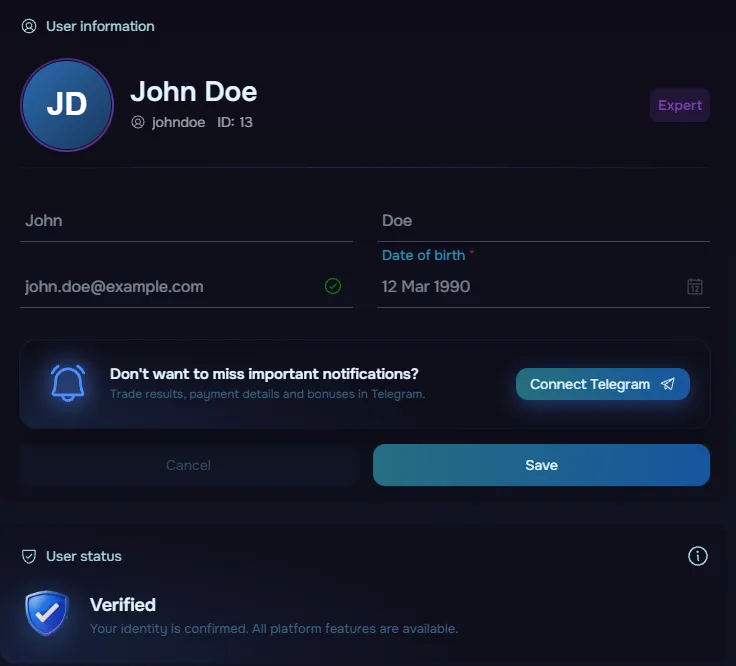
Before withdrawing funds, the user must pass a baseline identity check — Customer Due Diligence. The Platform collects and verifies the following data:
- Surname, given name, date of birth and citizenship.
- A copy of an identity document: a passport, an ID card or a driving licence.
- Proof of residential address: a utility bill or a bank statement no older than 3 months.
- Proof of ownership of the payment instrument used for operations.
- Contact details: a verified email address and phone number. (fig. 4.1)
Documents must be in colour, fully legible, with no cropped edges and free of graphic editing. The document must not be expired.
5. Enhanced Due Diligence (EDD)
Enhanced due diligence applies to higher-risk operations and clients. It may include requests for source-of-funds documents (income statement, asset sale agreement, bank account statement), video identification and additional questions about the purpose of the operations.
Politically exposed persons (PEPs), their relatives and close associates, as well as users whose data matches international sanctions or wanted lists, are subject to separate review.
6. Transaction monitoring
All operations undergo automated real-time monitoring. The system tracks anomalies and raises alerts for the responsible officer.
- Structuring: splitting a large amount into a series of small operations to stay under thresholds.
- Pass-through: a deposit followed by an immediate withdrawal with no trading activity.
- Profile mismatch: transaction volume significantly exceeding the declared income.
- Use of payment details belonging to third parties.
- Logins from different countries within a short period or signs of automated activity.
7. Restrictions and prohibitions
- Funding an account or withdrawing funds to third-party details is prohibited.
- Use of the service is prohibited for residents of sanctioned jurisdictions or countries on the restricted list.
- Anonymous use is prohibited: an unverified account has limited functionality.
- Depositing cash, or funds whose origin cannot be confirmed, is prohibited.
The Platform may suspend an operation, request additional documents or refuse service without stating reasons where AML/CFT requirements demand it.
8. Suspicious activity reporting
If indicators of a suspicious operation are detected, the responsible officer (MLRO) conducts an internal investigation and, where grounds exist, files a report with the authorised financial monitoring body.
The law prohibits informing the client that such information has been passed on (“tipping off”), so the Platform may restrict operations without detailing the reasons.
9. Record keeping
Copies of identification documents, transaction data and check results are stored for at least 5 years after the business relationship ends or after the date of the operation — whichever is later.
This data is processed in accordance with the Privacy Policy and in compliance with personal data protection requirements.
10. Responsibility and staff training
Implementation and compliance control of this Policy is the responsibility of the appointed Money Laundering Reporting Officer (MLRO), who acts independently of commercial units.
Staff involved in client servicing and payment processing receive regular training on identifying suspicious operations and current fraud typologies.
11. Consequences of breaches
- Temporary suspension of operations until the check is complete.
- Refusal to process an operation or to return funds to non-matching details.
- Blocking of the account and termination of the business relationship.
- Transfer of information to competent authorities in the cases provided for by law.